
Egypt is much more than a cruise along the Nile River visiting the cities of Aswan, Edfu and Luxor, as well as its capital, Cairo, discovering the traces of one of the most fascinating civilizations of antiquity. exists ‘another’ Egypt what’s going on … beyond temples, tombs, pyramids and museums; that of its oases and deserts.
Restricted for a long time, opened to tourism a decade ago, unknown to many as they are not within the popular tourist routes, they offer travelers the opportunity to visit small towns – where time seems to have stopped, marked by history, archaeology, traditions and ancestral customs -, discover fascinating natural places and live unique and magical experiences. And among the oases that the country of the pharaohs treasures – such as Kharga, Dakhla, Farafra, Al Fayum, Farafra or Siwa, to which we dedicated a report in ABC Viajar -, one stands out: that of Bahariya and its Black, Crystal and White deserts.
Bhariya, the ‘oasis of the north’
Located four hundred and twenty kilometers from Cairo, in the Egyptian western desert, in the heart of the Sahara, the Bahariya oasis, the so-called ‘oasis of the north’, is a paradise that occupies an area of two thousand square kilometers. Human settlement since predynastic times, famous for its wine during the New Empire – a splendor that lasted until Roman times -, it was a notable nucleus of Coptic Christians, as well as an important axis in the commercial routes of Bedouin caravans between Libya and Sudan.
Museum of Bedouin Art, Crystal desert and Black bahriya..
(Fran Contreras)
Bawitiits main town – an orchard made up of two million palm trees, crop fields and fruit trees, four hundred thermal springs and a surprising salt lake -, keeps authentic treasures that are a must-see such as; the valley, and museum, of the Golden Mummies, the Tombs of the Nobles, the remains of the temple of Alexander the Great, the Sanctuary-Tomb of the Saint in Qaret Sheikh Sobi or the Museum of Bedouin Art Mahmoud Eid, an artist whose clay works show the life, customs and traditional trades of Bahariya. A town that is also the base camp, the starting point, to discover the wild beauty of the Egyptian western deserts.
Black Desert, the Suda Sahara, the land of basalt
Not all deserts are made of golden sand. And that is what the traveler will discover as soon as he arrives at the Black desertknown as Sahara Suda. An immense plain of black, brown and yellowish tones formed by thousands of basalt and dolerite stones. The igneous rocks that volcanoes expelled more than one hundred and eighty million years ago, today conical-shaped hills that will appear on the four-by-four route.
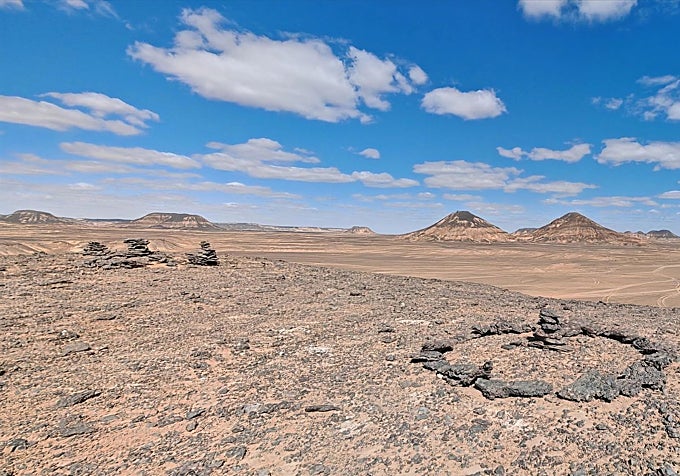
THE Black Desert, better known as Sahara Suda.
(Fran Contreras)
A journey in which you climb to the highest of all, the English mountain or British mountainfrom which spectacular and breathtaking panoramic views can be enjoyed. Its name is due to the surveillance post that the English troops of the Light Car Patrols, commanded by Captain Claud Williams, had here during the First World War, in charge of repelling the incursions of the Senussi tribe from Libya. A desert where, if you are attentive, you can see numerous fossils in the rocks. Not in vain, the findings of skeletons of big dinosaurs -such as the Carcharodontosaurus, the Bahariasaurus ingens, the Bahariya Abelisaurid or the Paralititan stromei, the last one, on the Jebel el Dist hill – have meant that since 2010 the Black Desert has been declared a Natural Reserve.
The Desert, and mountain, of Crystal and the dunes, and cave, of the Agabat Valley
The jeep route continues to one of the most unique desert areas not only in Egypt but in the entire world; the desert and Crystal Mountain. An extraordinary and dazzling landscape, never better said, in which hundreds of small luminous flashes appear on the arid ground. These are thousands of pure quartz and calcite crystals that come out of the earth forming an unparalleled spectacle under the light of the Sun.
Grouped and piled up, the greatest concentration is on a hill, the crystal mountain. A geological rarity that has its origin millions of years ago, when here, being the seabed, there was a hydrothermal cave of aqueous solutions rich in minerals, which ended up collapsing and leaving mineral crystals visible on the surface, of which there are twelve cataloged types.
Crystal Desert, dunes and cave of the Agabat Valley.
(Fran Contreras)
The tour continues until Agabat Valleythe so-called Valley of Wonders, the pass that leads to the White Desert. An impressive territory of endless plains, dunes and rock formations with whitish peaks that merge with the golden sand. It is accessed through a narrow passage with vertical walls and a vertiginous dune, as well as a gigantic cave, known as the Moon for its shape, which takes the traveler to the immense plain where sand and rock join hands, creating a Martian landscape.
White Desert, the Beda Sahara, ancient sands and fantastic white formations
If the Black Desert, the Crystal Desert and the passage through the Agabat Valley fascinate, the White Desert bewitches Known as Sahara Beda, it is one of the most magical places, as well as the best kept secrets, in Egypt. Declared a National Park in 2003, with an area of three thousand square kilometers, it is home to, among other animals, jackals, red foxes, sand cats or Rim antelopesan endangered species. Its ancient sands and capricious rocky masses are an unparalleled work of nature. It began to form millions of years ago, when the Tethys Sea receded, leaving the seabed exposed, the land being molded and polished by the passage of time and the elements.
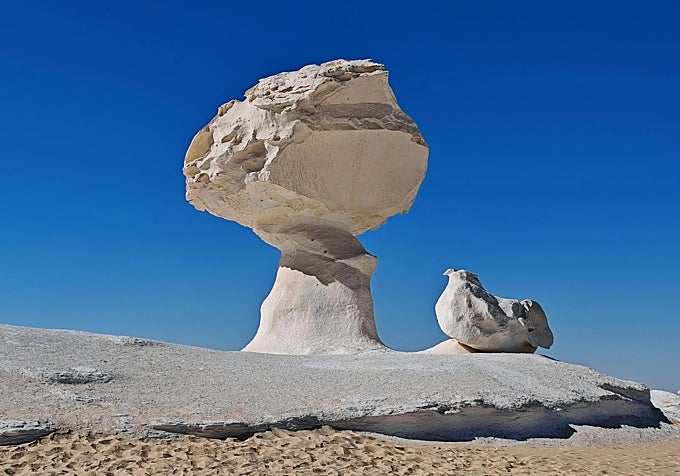
‘Mushroom and Pigeon’ sand formation.
(Fran Contreras)
As soon as you enter, the traveler will be able to see how the desert opens in all directions and always with a hypnotic white color, as if it were snowy or frozen. As you advance, dozens of formations of different sizes and curious shapes – of animals, plants and even humans – will appear in your path, chiseled not only by the wind and sand, but also by the drastic temperatures, capable of fragmenting them. The Bedouin guides say that only the hardest and purest are the ones that are still standing, and during the route, among the most unique, the Chess Horse, the Dromedary, the Face of the Child or the most popular, stand out. the Mushroom and the Dovesymbol of the White desert.
Nights in the desert, the magic of the stars
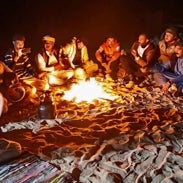
A trip in which a unique experience cannot be missing; that of sleeping, bivouac, in the desert, in the camps which the Bedouin guides set up and dismount for the night. Listening to the Bedouins, the ‘dwellers of the desert’, in the heat and light of the fire, with a good tea, after the dinner they prepare with rice, meat and vegetables, tell their history and stories, customs and beliefs, under a blanket of three hundred and sixty degree stars is magical. And if the night is magical – always protected from the djinns, genies and spirits of the desert sands -, the dawn that the traveler will experience is magical. The moment when, in the middle of nowhere, listening to an infinite silence, you see the first rays of the Sun appear on the horizon. Egypt is much more than pharaonic culture.
Tracks

How to get there:
Free access to tourists is prohibited. As they are protected spaces, some on the border and others adjacent to military zones, it is necessary to hire Bedouin agencies and guides, the only ones who have a license, as well as the capacity, to, always in four-by-four, access, tour and sleep in the deserts.Best time to travel:
Between the months of October to April, with temperatures between 15 and 25 degrees during the day, and between 0 and 5 degrees at night. Always keep in mind that some areas may be temporarily restricted by the Egyptian authorities.Recommended reading:
A good read, before and during the trip, is the book Bahariya and Farafra, by Ahmed Fakhry, an archaeologist who narrates the expeditions carried out in the 1930s.
So, dear reader, when you travel to the country of the Nile, do not forget to schedule, write down in your field notebook, two or three more days to be able to visit the Bahariya oasis -one of the ‘green islands’ that Herodotus called-, and its deserts -the Black, Crystal and White-, a natural treasure, where time stops, disconnects from the world, even from reality, and the genuine traveling, exploring and adventurous essence is lived and felt.

Sandra is experienced travel guide expert with a passion for exploration and cultural immersion.